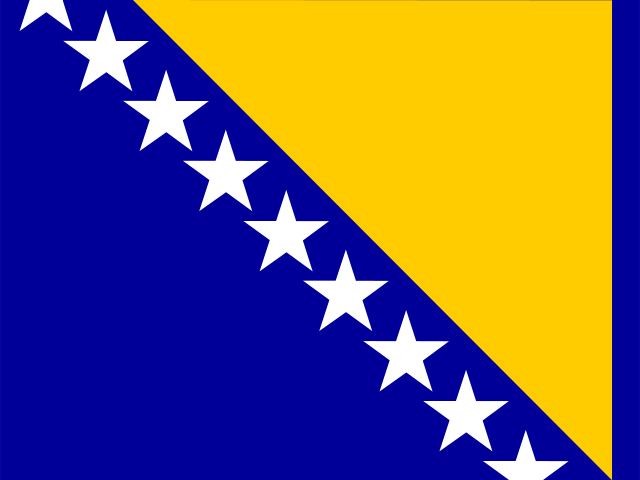
Bosnia and Herzegovina are back at the World Cup for the first time since 2014, and they did not get here quietly. A dramatic UEFA playoff campaign — beating Wales on penalties in the semi-final, then eliminating four-time champions Italy on penalties in the final — announced this squad to a wider audience before the tournament even began. Head coach Sergej Barbarez has named a 26-man squad that blends a 40-year-old captain and a 21-year-old American-born penalty hero. The contrast tells you everything about where this team is right now.
How Bosnia and Herzegovina Got Here — The Italy Upset That Changed Everything
Bosnia and Herzegovina's road to World Cup 2026 was defined not by conventional qualifying but by two of the most nerve-shredding UEFA playoff ties in recent memory. Sergej Barbarez's side first survived a penalty shootout against Wales in the semi-finals, navigating a tight tie that required composure and character in equal measure.
The playoff final against Italy was where the story truly took shape. Bosnia faced four-time world champions in a single-leg tie and, after a tense 90 minutes, took it to penalties. There, 21-year-old PSV winger Esmir Bajraktarević stepped up and scored the decisive kick to send Bosnia to North America. It was the defining image of their qualifying campaign: youth, nerve and belief in a moment that mattered.
In doing so, Bosnia became the first of the 48 qualified nations to publicly announce their final squad — a small but meaningful statement of organisation and intent from a federation that has learned hard lessons since 2014.
Key Players to Watch
The Official Squad: Džeko's Injury Concern, the Mahmić Controversy, and a Born-in-America Hero
The biggest fitness story surrounding the squad is Edin Džeko. The captain suffered a shoulder injury in the dying seconds of extra time against Italy — he watched the penalty shootout with his arm in a sling and was unable to take a kick. He missed four Schalke club matches before returning as a substitute in their final two games. Barbarez has named him regardless, and the expectation is that Džeko will build toward fitness through the group stage, with Demirović covering the heavier workload early on.
The most controversial selection is Ermin Mahmić. The 21-year-old Slovan Liberec midfielder had previously represented Austria at Under-17 and Under-21 level before receiving FIFA approval to switch allegiance to Bosnia just weeks before the squad announcement. He arrives uncapped at senior level. Eighteen-year-old Kerim Alajbegović of RB Salzburg — the youngest player in the squad — carries similar logic of investing in future talent alongside tournament experience.
Bajraktarević adds another layer to the story: born in Appleton, Wisconsin and a former US youth international, he officially switched to Bosnia in 2024 before scoring the penalty that eliminated Italy in front of a stunned European audience. Veteran midfielder Rade Krunić is absent — a deliberate signal from Barbarez that the midfield engine will be rebuilt around a younger generation. Miralem Pjanić, Bosnia's other icon of the 2014 era, retired in December 2025, leaving Džeko as the last survivor carrying that legacy.
Group B: Canada, Switzerland and Qatar — A Realistic Knockout Path
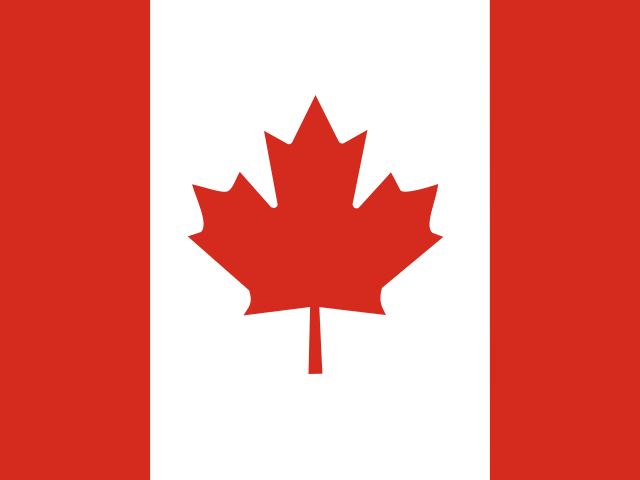
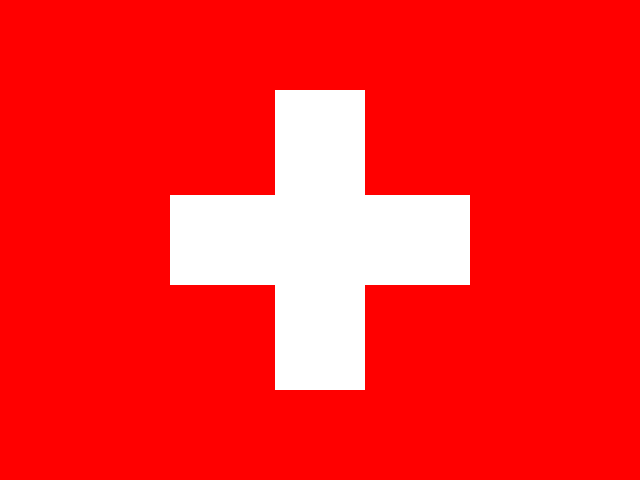
Bosnia and Herzegovina have been drawn in Group B alongside co-hosts Canada, Switzerland and 2022 hosts Qatar. On paper this is a group that gives Bosnia a genuine path to the Round of 32 — their first knockout appearance at a World Cup. Their opening match is against Canada on June 12 in Toronto.
Canada will carry host-nation momentum, while Switzerland are the most tactically organised opponent in the section. Qatar, playing as former hosts, represent the most accessible points in the group. Bosnia need to be clinical against them and at least competitive against Canada and Switzerland to have any chance of progressing.

World Cup History
One to Watch — Esmir Bajraktarević
Prediction
Think you know how Bosnia and Herzegovina will do at World Cup 2026?
Pick every match from the group stage to the Final on July 19. Free to play — predictions lock June 11.
World Cup 2026 Bracket Predictor →Collect the WC 2026 Sticker Album
Track your Panini collection, mark duplicates, and find trade partners worldwide.
Open Sticker Album →