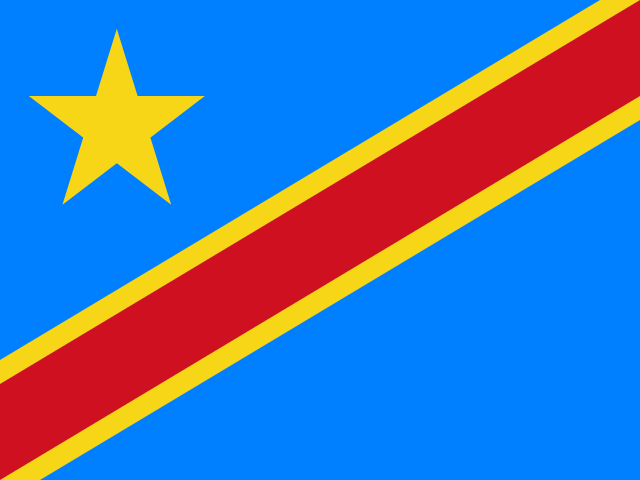
DR Congo have named their World Cup 2026 squad — and Aaron Wan-Bissaka is in it. The West Ham right-back, who came through Crystal Palace, played for Manchester United and appeared in England youth football, has chosen the Democratic Republic of Congo. His commitment — alongside Yoane Wissa at Newcastle — gives the Leopards two Premier League-quality players in a squad that aims to reach the knockout rounds for the first time in the nation's modern history. Chancel Mbemba captains. Gaël Kakuta plays one final chapter. And a midfield of ten players reflects a side that intends to compete.
Wan-Bissaka's Choice — The Decision That Defines the Squad
Aaron Wan-Bissaka's commitment to DR Congo is the squad announcement's defining story. He played for England at U20 level, was on the radar of the senior England setup, and ultimately chose his parents' nation. At West Ham, he has rebuilt his career after a difficult spell at Manchester United — arriving at this World Cup in his best form since leaving Crystal Palace.
The decision follows a wider pattern of dual-nationals choosing African nations over European ones at this cycle. For DR Congo specifically, Wan-Bissaka's commitment sent a message about the federation's ambition and the quality of the project being built around Mbemba's leadership and Wissa's attacking talent.
Gaël Kakuta's inclusion at 33 is nostalgic and practical in equal measure. The midfielder — once touted as one of the most gifted teenagers in Europe at Chelsea — has had a career of perpetual promise and inconsistent delivery. At AEL Limassol he has found stability. His experience of European football at its highest levels, even if years ago, brings a frame of reference the younger players in the squad lack.
Noah Sadiki (Sunderland) and Ngal'ayel Mukau (Lille) represent the squad's next generation. Both are under 22, both have developed at serious European clubs, and both are capable of stepping into bigger roles as the tournament progresses.
Key Players to Watch
Ten Midfielders — DR Congo's Philosophy
Ten midfielders in the squad reflects a philosophy built around controlling central areas, pressing in waves and using the wide midfielders — Mbuku, Elia, Bongonda — to stretch opposition defences. Wan-Bissaka overlapping from right-back feeds into this width-based approach.
The forward line is compact: Wissa, Banza and Bakambu. Banza (Al Jazira) has been one of the most clinical strikers in the Middle East over the past two seasons. Bakambu provides the link-up option. Wissa is the primary goal threat. It is a forward group that can hurt anyone if given chances.
Group K — DR Congo's Route
DR Congo are in Group K alongside Colombia, Uzbekistan and one other team. It is a group where second place is genuinely achievable. Colombia are the clear favourites, but Uzbekistan and the other qualifier are at a level where DR Congo's individual quality — particularly Wissa and Wan-Bissaka — can be decisive.
The tactical battle against Colombia will define their tournament. If Mbemba and Wan-Bissaka can limit Luís Díaz's wide threat, DR Congo can compete for 90 minutes. A draw would open the group completely.
World Cup History
One to Watch — Yoane Wissa
Prediction
Think you know how DR Congo will do at World Cup 2026?
Pick every match from the group stage to the Final on July 19. Free to play — predictions lock June 11.
World Cup 2026 Bracket Predictor →Collect the WC 2026 Sticker Album
Track your Panini collection, mark duplicates, and find trade partners worldwide.
Open Sticker Album →