
Qatar are back at the World Cup having actually qualified for it this time. In 2022, as co-hosts, they became the most embarrassing host nation in tournament history — first team ever to lose all three group matches, finish without a point, and go home before the knockout rounds began. That wound has shaped everything about how this squad has been built. Julen Lopetegui, brought in as head coach in May 2025, has called Hassan Al-Haydos out of retirement, built a system around Akram Afif's creative force, and watched Almoez Ali score 12 goals in AFC qualifying to put himself forward as a genuine attacking threat. Whether the Maroons can actually compete in Group B against Canada, Switzerland and Bosnia remains genuinely uncertain. But the squad is more serious than the host-nation vanity project of 2022.
How Qatar Got Here — AFC Qualifying and the Weight of 2022
Qatar qualified for World Cup 2026 through the AFC's fourth round, winning their group ahead of UAE and Oman. This is the detail that matters most about this squad before a tactical analysis begins: unlike every other team at the tournament, Qatar in 2022 did not have to qualify. They walked in as hosts, lost everything, and were sent home without a point. In 2026, they had to earn it.
The AFC qualifying campaign was anchored by Almoez Ali, who finished as the confederation's top scorer with 12 goals across the campaign. Afif added creativity and Lopetegui — who arrived in May 2025 after the previous cycle of coaching changes — imposed enough tactical structure to give Qatar a consistent identity for the first time since 2022.
The squad announcement also brought one notable story back to the surface: Hassan Al-Haydos, who retired from international football in March 2024, was personally asked by Lopetegui to return. He agreed. At 35 and 188 caps, Al-Haydos now heads to a World Cup he probably thought was behind him — with something to prove on behalf of an entire football nation.
Key Players to Watch
The Official Squad: Afif's Last Chance at a Global Stage, Al-Haydos Comes Out of Retirement, and One European Club
The goalkeeping unit is entirely domestic. Salah Zakaria leads from Al Duhail, with Meshaal Barsham of Al Sadd and Mahmoud Abunada of Al Rayyan in reserve. This is one of the strongest indicators of where Qatar's football infrastructure still sits in global terms — no European-based goalkeeper available or selected.
The defence has one notable outlier: Homam Al-Amin of Cultural Leonesa, Spain's third tier, is the only player in the squad based at a European club. The rest of the defensive unit, including Boualem Khoukhi and Pedro Miguel at Al Sadd, Sultan Al Brake and the naturalized Lucas Mendes, all play domestically in the Qatar Stars League. Issa Laye adds pace from Al Arabi.
In midfield, the structure is built around Assim Madibo's defensive screening, with Ahmed Fathi, Abdulaziz Hatem, Karim Boudiaf and Jassim Gaber competing for the creative midfield positions. Al-Haydos, nominally a forward-midfielder, will likely operate from a deeper starting point than his peak years.
The attack is where Qatar's tournament ambitions live or die. Akram Afif and Almoez Ali together represent one of Asian football's most dangerous pairings in the continental context. Tahsin Mohammed, Edmílson Junior and Mohammed Muntari provide depth and physical presence. Ahmed Al-Ganehi and Yusuf Abdurisag complete a forward group that gives Lopetegui variety if not elite global quality.
Group B: Canada, Switzerland and Bosnia — The Toughest Draw Qatar Could Have Hoped to Survive
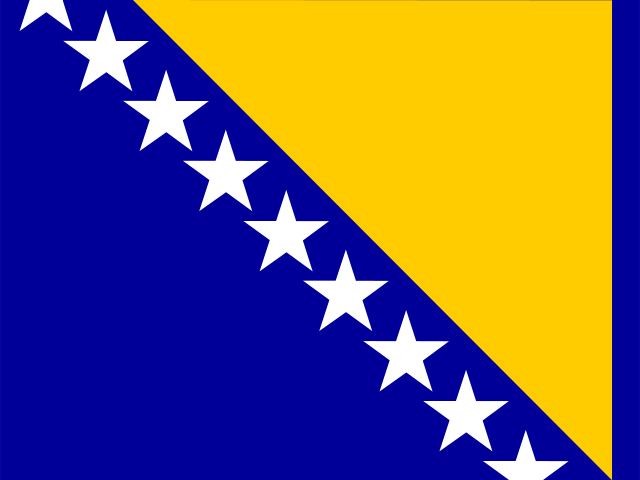
Qatar face Switzerland on June 13 in Santa Clara, Canada on June 18 in Vancouver, and Bosnia and Herzegovina on June 24 in Seattle. On paper this is a group that most analysts regard as beyond Qatar's realistic reach — Canada as co-hosts carry momentum and genuine quality, Switzerland are one of the tournament's most tactically organised sides, and Bosnia qualified through two dramatic penalty shootouts.
The realistic target for Qatar is the Bosnia match on June 24, which shapes up as the group's deciding game for the second and third spot. If Afif and Ali can function at the level they have shown in AFC competition and Lopetegui's defensive structure holds, a point against one of the stronger sides is not impossible. A win over Bosnia would be a genuine achievement.


World Cup History
One to Watch — Akram Afif
Prediction
Think you know how Qatar will do at World Cup 2026?
Pick every match from the group stage to the Final on July 19. Free to play — predictions lock June 11.
World Cup 2026 Bracket Predictor →Collect the WC 2026 Sticker Album
Track your Panini collection, mark duplicates, and find trade partners worldwide.
Open Sticker Album →